Machinery built in Britain +44 (0)1706 369000 sales@pipautomation.com
The PiP test rig

Will your tray automate?

Prove it before you commit.

A tray can be perfect for filling, sealing and presentation and still be difficult to denest reliably. Our in-house test rig lets us assess the packaging itself before full production equipment is specified.

Send us your trays. We’ll run them, record the trial and show you what happens.

44 second trial reel: foil, card, barrier-lined paperboard, pulp and recycled plastic on the rig. Click to play with sound.
What we assess

What we look for.

Every trial answers the questions that decide whether a tray will run reliably at production speed:

SeparationDoes one tray release cleanly from the stack, every cycle?
Stack behaviourHow the stack holds, feeds and behaves from full to nearly empty, including maximum and minimum workable stack sizes.
VariationDifferences between trays and between batches, and what they mean for reliability.
Flange & denesting featuresHow the tray’s own geometry helps or hinders separation.
Pick-up & releaseCup type, position and count for a clean pick and a controlled, square placement.
Production-speed suitabilityThe rig is HMI-run, so trays are tested at the rate the real line will demand.
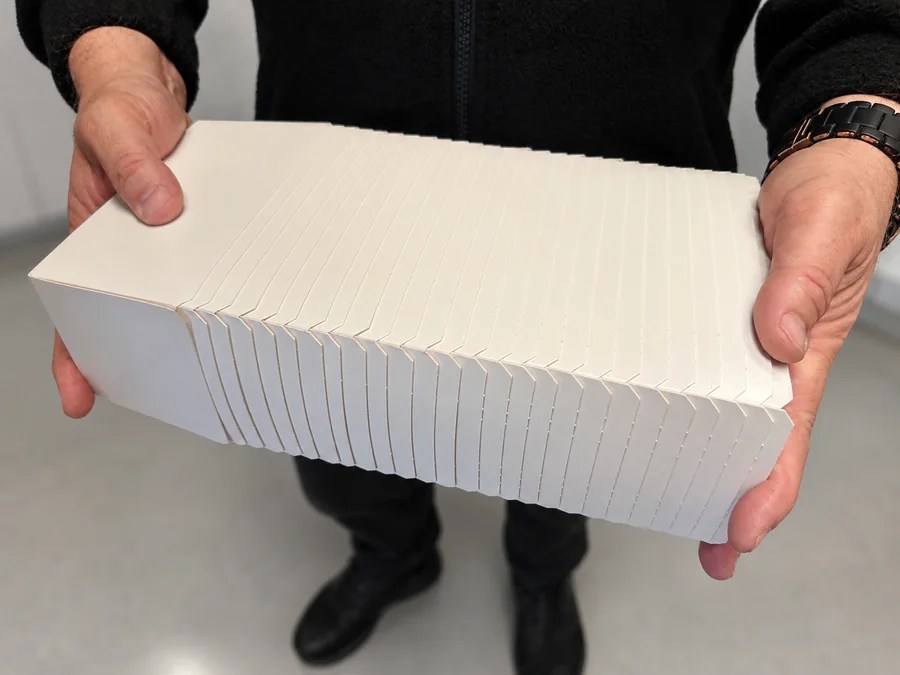
A tightly locked stack of card trays as received for testing

This is what packaging can look like when it arrives: a stack locked tight enough to defeat a standard denester. It’s exactly the sort of problem the rig exists to solve, and the reason we test real production samples rather than perfect ones.

How the rig works

A fully adjustable version of a production machine.

The test rig is a special build of our most installed denester platform, made completely adjustable. It takes trays from 80 mm to 500 mm wide and stacks up to 300 mm high, so almost any format can be trialled.

Five standard holding-clip types, three pick-frame arrangements and our most successful suction cups, selected from more than fifty types trialled over the years, can be swapped and repositioned in minutes until the tray runs cleanly.

Every adjustable part carries a measurement scale. When a setup works, we record it, and those numbers feed straight into the design of your production machine’s tooling. Right first time, without guesswork.

The test station tooling board: suction cups, clips and pick frames
The tooling library beside the rig: suction cup types, five standard clip designs and the three pick-frame arrangements.
Straight pickThe cup goes straight into the tray. Simplest and cheapest to run; no pneumatic cylinders.
Actuated pickA cylinder gives the cup extra reach for deeper or more rigid trays.
Sidewall pickPicks on the cavity wall instead of the base. Ideal for card trays; can cut change parts across similar trays.

Testing all three pick types before a machine is quoted often reduces its cost: if a tray runs on a straight pick, you never pay for cylinders it doesn’t need.

What you get back

A recorded answer, not an opinion.

  • Trial footage showing exactly how your trays behave on the test equipment. We’ll even send you the video.
  • Engineering feedback on separation, stack behaviour, variation and any obvious automation risks.
  • A clear engineering view on whether the tray appears suitable for repeatable automated denesting at your target rate.
  • A recommended next step: packaging changes, additional testing, or a machine and application discussion.
The test rig and test station in the PiP factory
The rig is HMI-operated, so trials run at intended production speed, not demonstration speed.
Proven across materials

Hundreds of trays tested. Every material that matters.

The rig has run fibre, foil, recycled plastic (which can be brittle), barrier-lined paperboard trays, including MAP and Vacuum Skin Packaging (VSP) trays, moulded pulp and conventional thermoformed trays: hundreds of formats, recorded and codified into a growing knowledge base that makes the next difficult tray quicker to solve.

Fibre & board
Foil
Recycled plastic
Barrier-lined paperboard trays
Moulded pulp

Hover over a material to see it running on the rig. On a phone, tap to play and pause.

Who it helps

Get automation involved earlier.

Food manufacturersTest a proposed pack before committing to production equipment, and before committing to the pack itself.
Packaging manufacturersSee how a new tray behaves in automated denesting and use the findings during development.
Machine builders & integratorsDe-risk the packaging infeed before the complete line is finalised.
The trial process

Send. Test. Review. Automate.

1
SendRepresentative production samples, ideally from more than one batch, including any known difficult trays.
2
Tell usThe required rate, line pitch and downstream process.
3
We testWe run the trays on the rig, record the trial and review the results with you.
4
AutomateIf automation is viable, we discuss the most appropriate machine and next steps.

Got a difficult tray? Send it to PiP.

Prove the tray before you commit to the machine. Send us the packaging, give us the problem, and we’ll show you exactly how it runs.