
Built around the pack. Built for production.
PiP designs and manufactures specialist feeding and placing equipment for food production lines. Our machines automate the repetitive first step: separating packaging from a stack or magazine and placing it accurately where the next process needs it.
Choose by what you need to feed.

Tray Denesters
A · AS · C · R Series
Pick-and-place denesting for plastic, foil, board and fibre trays. Pneumatic (A) or servo (AS) drive; intermittent, continuous and rotary motion options.
See tray denesters
Card & Board Feeders
F Series
Base cards, U-boards, bakery boards, folded cards and inserts, fed and placed accurately at line speed.
See card feeders
Lidders
AL · ALS · RL Series
Pick-and-place and rotary lidding for pots, tubs and trays, including board and fibre lids as formats change.
See lidders
Pot Droppers
B Series
Accurate separation and placement of nested pots and containers.
See pot droppersOne denester. Multiple tray materials. Changeover in minutes.
Run plastic, foil and fibreboard trays on the same PiP denester. Factory pre-set tray masks and removable suction tooling make changing between tray sizes and materials quick and simple, typically taking just minutes.
As your packaging changes, your denester can change with it. Choose a denester that can adapt.
The machine platform may be proven, but the packaging is never assumed. We test the actual pack, understand how it separates and behaves, then configure the tooling, magazine and controls around the application.
That approach gives customers a production solution rather than a machine that only worked with a perfect sample.
Where an application calls for something beyond the standard range, we build bespoke systems on our proven platforms, where the application justifies the engineering.
Send us your packaging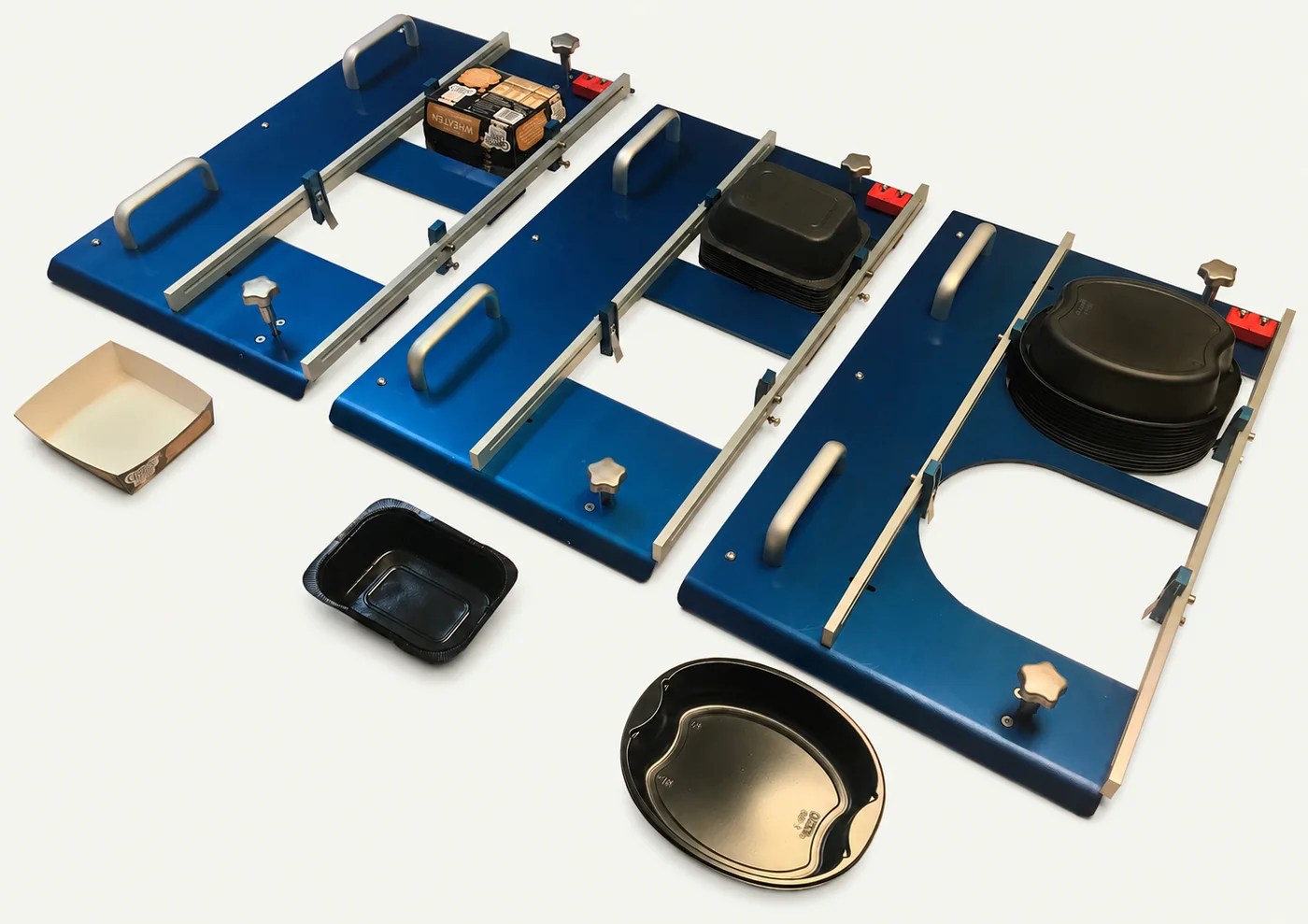
Format masks from a PiP machine, each configured around a different tray. One platform, many packs.
When the standard range isn’t the answer.
Special engineering, built on proven platforms.
Most applications are solved by configuring our standard machines around the packaging. Some are not. Where the application justifies the engineering, PiP designs and builds bespoke systems on our proven platforms: special formats, unusual line arrangements and handling problems no catalogue machine covers.
Recent showcases include the S Series stack-to-stack system and the RT Series Tip-on system, which applies sachets, cards and pouches onto a base card at line speed.
A tray manufacturer wanted to pre-label buckets for their customers
The buckets would not stack vertically and were difficult to separate. Built on our S Series platform, this line adds a 12 x 80 bucket magazine autoloader set at a 10 degree angle, a positive bucket separation system and an individual counter that restacks to any count set on the HMI. It runs 24 hours a day, 7 days a week.
The RT Series Tip-on system, sachets, cards and pouches applied at up to 120 a minute
The RT Series is a four head rotary pick and place machine that picks sachets, cards and pouches and places them onto a base card or base sheet, the format known as a Tip-on system. A typical system pairs it with our F Series card feeder, or a second R Series, to feed the base substrate, a high speed chain and peg transport conveyor, and our patented Flowfold technology for folding cards into a folder or wallet style finished product. It handles a wide variety of items that stack in a magazine, at speeds of up to 120 per minute.
A barbecue manufacturer needed foil trays fed in a potentially explosive environment
Charcoal dust makes a disposable barbecue line a potentially explosive environment, which is why every conveyor on this line is ATEX rated. Our A Series places two sizes of foil tray into an open, easy-clean indexing conveyor, and changeover between two small trays and one large is set from the HMI. Each tray is shaken to level the coals, a friction feeder lays the fire sheet on top, and a four-metre conveyor gives operators time to position the foil mesh and turn down the top flange. Wheel-out bins under the conveyor catch spilt coals for recycling, and nothing is wasted.
Trays that refuse to separate without a blade between the flanges
Trays fitted with soak pads, and rigid trays that lock together in the stack, need more than gravity to separate. The i Series controls the tray on all four flanges and inserts reciprocating blades between them, releasing one tray at a time, cleanly and at speed, with no change parts across a wide size range. Belt-driven bulk magazines provide high-capacity storage, and servo drives with a large touchscreen HMI keep set-up simple. Designed for easy integration into OEM machines, it is available in full washdown format and backed by our preventative maintenance packages.
A sushi producer needed base trays fed and lids pressed on at line speed
On this sushi line our A Series feeds the base trays and our AL Series presses the lids home. The AL Series is compact, hygienic and cantilevered, with the product path at the front and the mechanics behind, which means the quick-change belts simply lift out for cleaning. An integral transport belt with an arresting device holds each pack in position for lidding, and formats are factory-set masks that a semi-skilled operator changes in minutes through the password-protected HMI. Stainless steel as standard, full washdown as an option.
Cups that topple, tubs that lock, pots that must land exactly right
Cups that are unstable, tubs that lock together in the stack, buckets that fall over, pots that must be placed with real accuracy: these are the applications that stop an ordinary denester. Reliability is everything, which is why we match the platform to the problem, the flexible intermittent A Series, the twin-servo C Series in intermittent and rotary forms, and the high-speed rotary R Series. Where none of the standard range is the perfect fit, we build the answer on the B Series.
The machine has to earn its place on the line.
One manual packing station across three shifts now costs upwards of £95,000 a year. Work out what automation would pay back from your own shift pattern, labour cost and line count.
Send us the packaging. Give us the problem.
You do not need to arrive with a finished machine specification. Tell us what you are running, the rate you need and what is causing the problem. If you have samples, send them.
Integrating PiP equipment into a new OEM line? See how we work with packaging machinery manufacturers.